EVENT REPORT
Event Report of Whole-Life Discipleship & CAFO Collaborate Conference: 22nd – 23rd September 2026
Focus Sphere: Family & Children Discipleship (Caring for Vulnerable Children, Family Preservation, and Holistic Mentoring)
Collaborative Partners: LORD’S HOME / Whole Life Discipleship (WLD) Pakistan Network & Christian Alliance for Orphans (CAFO Global Network)
Date of Event: 22nd – 23rd September 2026
Mode & Venue: Online Participation / Virtual Global Link connected directly to Collaborate 2026 (Live from Atlanta) with physical regional gathering hubs
Name of Reporter: LORD’S HOME, 137 Hamza Town, Ferozepur Road, Lahore, Pakistan
Date of Report: 24th September 2026
What were the goals for this event?
The primary purpose of this two-day summit was to connect national leadership across Pakistan into the global CAFO (Christian Alliance for Orphans) movement under the local umbrella identity of Whole Life Discipleship (WLD). Grounded in the Family & Children Discipleship sphere of the WLD 7 Spheres model, the conference aimed to move Christian leaders from institutional approaches toward sustainable family preservation, orphan care, and community-embedded mentoring.
Core Aims & Strategic Objectives:
- Establish the Local CAFO Chapter: Formally position the (Whole Life Discipleship) WLD Movement as the national platform and local network partner for CAFO in Pakistan.
- Embrace the “LESS” Framework: Participate in the global theme of pruning superfluous activities, simplifying organizational burdens, and focusing on biblically rooted, restorative care for vulnerable children.
- Apply the Chalmers “Innovate” Process: Train pastors, organizational heads, and youth workers in the 3-step design process: Discover (look and listen), Design (think and create), and Do (test and improve) to design interventions that help without hurting.
- Contextual Project Prototyping: Transition from passive listening to active collaboration during Day 2 by commissioning 6 dedicated working tables to design practical, local prototypes uniting local churches, NGOs, and communities for family preservation.
Event Logistics & Multi-City Hybrid Participation
The conference connected participants through a hybrid virtual link, bringing together leadership across three strategic cities:
Location / Hub | Participants | Context & Coverage |
Lahore Hub | 31 | Represented leaders, pastors, and social workers mobilized from 15 nearby locations/colonies across the Lahore district. |
Raiwind Hub | 9 | Online link connection engaging local church workers and community facilitators. |
Islamabad Hub | 5 | Online link connection engaging northern regional focal leaders and coordinators. |
Total Attendance | 45 | United ecumenical and organizational presence across Pakistan. |
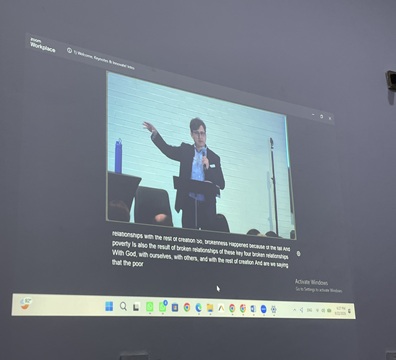
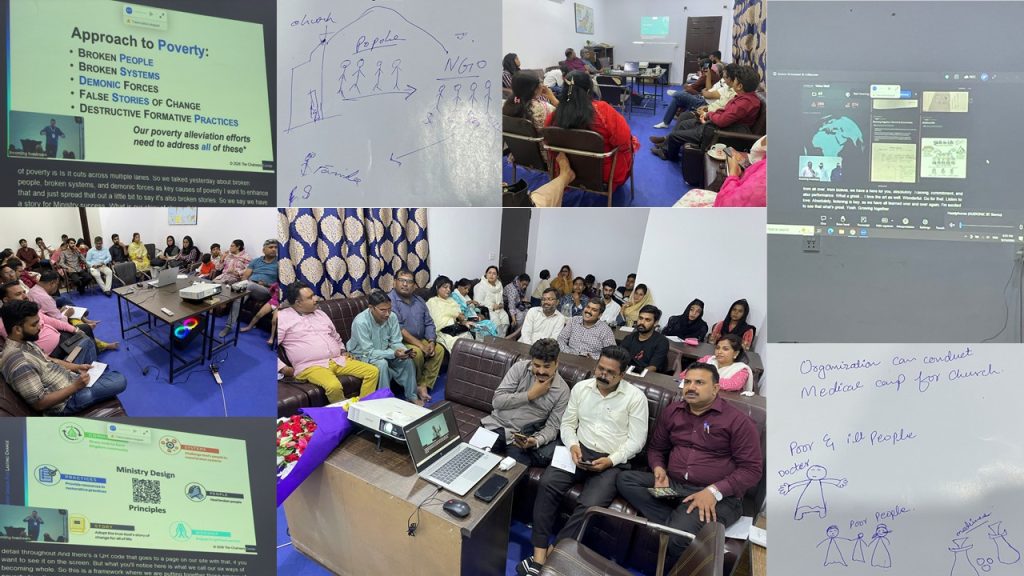
The local Lahore facility was arranged with high-speed internet links, uninterrupted power backup, projection systems for the global Atlanta livestream, and collaborative breakout spaces for roundtable drafting.
Program Structure & Key Themes
The event followed the official CAFO Collaborate schedule, pairing live global sessions from Atlanta with localized roundtable applications:
- Day 1 (22nd September):
- Welcome & Keynotes: Opening address on the biblical theology of pruning (John 15:2) led by David Hennessey and the CAFO Global Network team.
- The “LESS” Mindset: Understanding how overgrowth and administrative complexity crowd out intimate family discipleship.
- Innovate Workshop Introduction: Presentation of the Chalmers Center framework—identifying that poverty and brokenness stem from broken relationships with God, self, others, and creation, driven by broken people, broken systems, and spiritual warfare.
- The Humanitarian Spectrum: Learning to distinguish accurately between Relief, Rehabilitation, and Development to prevent long-term community harm.
- Day 2 (23rd September):
- Ministry Design Principles: Exploring kingdom community, adopting God’s story of change, and restorative practices.
- Prototyping & Collaboration (Breakout Session): Working across 6 tables to identify community assets (churches, NGOs, children, communities) and produce visual intervention prototypes.
- Action Commitments: Drafting personal and organizational “Intention Statements” for immediate field implementation.
Collaborative Group Prototyping: 6 Table Projects
During the Day 2 practical workshop, the 45 participants were organized into 6 dedicated working tables to design grassroots collaborative prototypes bridging local churches and community initiatives. Each table presented their concept and action plan:
Table 1: Project “From Brokenness to Hope” (Family Preservation & Adoption)
- Concept & Mechanism: Addresses the plight of hopeless, fatherless, and abandoned children in society. The local church identifies vulnerable orphans and broken households in its parish. In partnership with the WLD/CAFO network, the church acts as a bridge to identify and counsel willing Christian families to adopt or foster children, moving them out of institutions into loving, permanent homes.
- Core Principle: Transitioning a child from vulnerability to security: Church identifies $\rightarrow$ Network assists with process $\rightarrow$ Family adopts $\rightarrow$ Child receives a home and family identity.
Table 2: Project “Education Development for Underprivileged Children”
- Concept & Mechanism: Focuses on marginalized children deprived of formal schooling due to extreme poverty. The local church leads by providing its physical facilities during weekdays to run non-formal primary schooling, childhood development classes, and adult literacy for uneducated mothers.
- Collaborative Link: NGOs and professionals supply teachers, curriculum, and classroom supplies, while the church provides pastoral oversight and community trust.
Table 3: Project “Community Medical & Holistic Health Camps”
- Concept & Mechanism: Bridges urgent health crises among impoverished Christian families who cannot afford doctors or medications.
- Action Plan: NGOs arrange volunteer Christian doctors and supply essential medicines, while local churches host free community health screenings and follow up with prayer, pastoral counseling, and long-term wellness discipleship.
Table 4: Project “Restoring Broken Hearts & Holistic Transformation”
- Concept & Mechanism: Visualizes the journey of an individual from despair to empowered discipleship. Pastors and church workers go out to find broken, financially oppressed, and hurting people in local streets.
- Action Plan: Believers are welcomed into the church community where they experience Christ-centered healing, counseling, and practical empowerment, eventually growing into mature disciples who give back to serve other broken families.
Table 5: Project “Child Rescue & Institutional Education Link”
- Concept & Mechanism: Focuses on children in orphanages and care centers who lack parental love and emotional nurture.
- Action Plan: Connects orphan care centers with structured, high-standard Christian educational institutions. The project pairs institutionalized children with volunteer church “mentor families” who provide parental affection, emotional development, and moral role-modeling so children do not grow up feeling institutionalized or psychologically isolated.
Table 6: Project “Pastoral Care & Ministerial Family Support”
- Concept & Mechanism: Acknowledges the overlooked vulnerability of pastors’ and church workers’ own families. Rural evangelists and frontline pastors often face extreme poverty and burnout, leaving their own children feeling abandoned and bitter.
- Action Plan: Establishes a mutual support cooperative where larger urban churches and Christian resource organizations provide scholarships, emergency relief, and family retreats for pastors’ children, ensuring that shepherd families are cared for and sustained.
Outcomes of the Conference
- Official Launch of CAFO Local Network: The national Whole Life Discipleship (WLD) movement is now formally positioned as the domestic platform and facilitator for the CAFO Global Network in Pakistan.
- Multi-City Unity: Strong participation from Lahore (31), Raiwind (9), and Islamabad (5) demonstrated the viability of decentralized, hybrid training hubs across provincial lines.
- Practical Mindset Shift: Church leaders and organizational heads moved away from standalone, blueprint charity models to participatory, asset-based designs that strengthen biological and foster families.
- 6 Viable Community Prototypes: Local working groups produced visual, actionable plans that will be piloted across the 15 represented Lahore communities and regional partner hubs.
Future Steps & Action Plan
- Pilot Prototype Testing: Coordinate with Table leaders to test their specific project prototypes (particularly the Adoption/Fostering initiative and Non-formal Education models) in select local communities.
- Facilitator Coaching Cohorts: Connect key regional leaders into CAFO’s Journey Together spiritual formation cohorts and global learning webinars.
- National Awareness Days: Mobilize partner congregations across Lahore, Raiwind, and Islamabad to observe Pure Religion Sunday in November, raising corporate prayer and congregational commitment for vulnerable children and widows.
- Resource Translation: Finalize Urdu adaptations of family preservation materials, trauma-competent care resources, and the Innovate design guide for grassroots church workers.
Report Compiled by:
National Coordination Team
Lord’s Home / Whole Life Discipleship (WLD) Pakistan
In Collaborative Partnership with CAFO Global Network
Lord’s Home is doing great work in Pakistan